|
Images not loading, or having trouble viewing this email? View Online |
|
|
|
|
|
|
|
Director's Update
Welcome to the first edition of the GETCO2 newsletter!
GETCO2 is a recently awarded $45M, 7-year Australian Research Council Centre of Excellence focusing on Green Electrochemical Transformation of Carbon Dioxide. The Centre comprises Chief Investigators from seven Australian universities, with national and international Associate and Partner Investigators.
Together, we aim to develop the technologies and build the capacity to enable the conversion of carbon dioxide into valuable products such as chemicals and fuels. Our ambitious goal is to catalyse a green manufacturing and export revolution for Australia, while paving the smartest and cleanest path to Net Zero.
We encourage your involvement in the Centre and I hope to see you at our upcoming Centre Launch and Industry Workshop. We will be sending invitations to these exciting events soon - feel free to forward the invitation to your network and colleagues. In the meantime, please save the date, Tuesday 30th July, and contact us on getco2@uq.edu.au for further information.
Tackling the big challenge of carbon dioxide will take a collaborative approach with contribution across sectors and disciplines. I look forward to working with you on this grand endeavour as we build a critical mass in CO2 transformation.
Best wishes
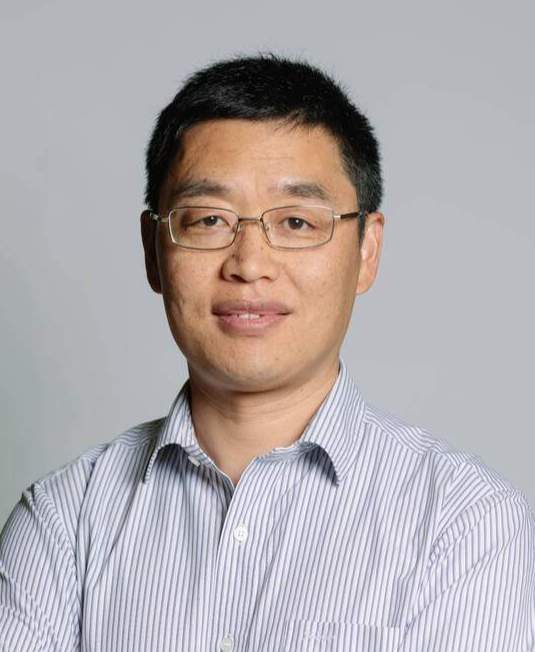
Professor Xiwang Zhang
Centre Director |
|
|
|
|
|
|
|
|
|
Nanogenerator turns CO2 into Sustainable Power
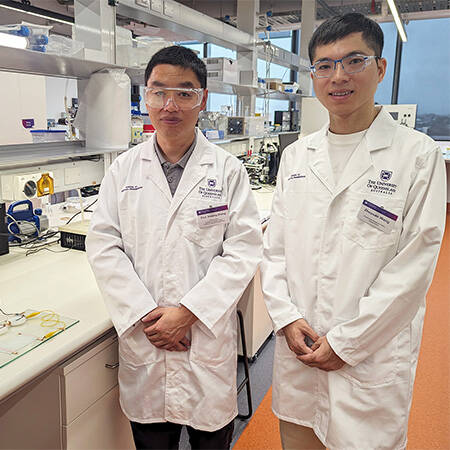
Dr Zhuyuan Wang and Professor Xiwang Zhang from GETCO2 and UQ Dow Centre for Sustainable Engineering Innovation have built a generator that absorbs carbon dioxide (CO2) to make electricity.
The nanogenerator is made of two components: a polyamine gel that is already used by industry to absorb CO2 and a skeleton a few atoms thick of boron nitrate that generates positive and negative ions. The ion separation generates a diffusion current which can be amplified into electricity.
Their proof-of-concept nanogenerator can harvest around 1 per cent of the total energy carried intrinsically by CO2, and the researchers are now working on improving efficiency and reducing cost.
Zhuyuan and Xiwang's research has been published in Nature Communications. | |
Find out more >> |
|
|
|
|
|
|
|
|
|
CO2 Reduction Reaction Workshop
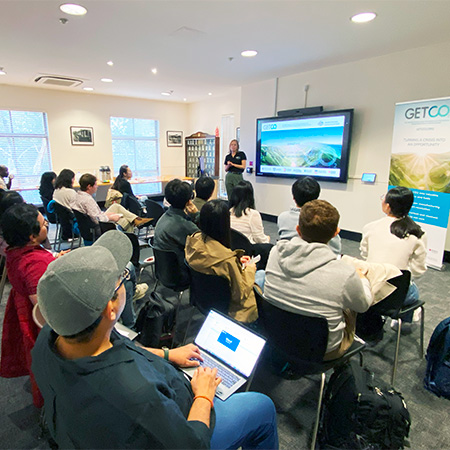
In early May, we held our first electrochemical CO2 reduction reaction (CO2RR) training workshop. The 2-day laboratory-based workshop was led by Chief Investigator Dr Fengwang Li, Dr Aoni Xu and Ms Yu Yang from The University of Sydney, and attended by 22 PhD students and postdoctoral research fellows from GETCO2's nodes at UNSW, RMIT, UQ, UoA, USyd and Griffith.
Amidst presentations on experimental protocols, electrocatalysis theory and lab demonstrations, we also had time for a session about capacity building led by GETCO2 Chief Operations Officer Dr Eloise Larsen.
The feedback was overwhelmingly positive - in particular, the participants enjoyed the opportunity to meet face-to-face and exchange ideas. The students and postdocs also suggested different types of training activities and skills they would like to learn in addition to their research.
Big thanks to Fengwang, Aoni and Yu for running the workshop and Kaori Sugita and Aimee Sisley from GETCO2's operations team, for their meticulous coordination of logistics! |
|
|
|
|
|
|
|
|
|
Work with us!
Join GETCO2 and help us shape the net zero future!
Our researchers are currently offering a number of exciting PhD scholarships and postdoctoral research opportunities. Head to our website for more information.
We welcome collaboration with industry partners! To find out more about how we can work together contact getco2@uq.edu.au and join our Industry Workshop on 30 July 2024. | |
See our opportunities >> |
|
|
|
|
|
|
|
Upcoming GETCO2 events
- 16 July: 1st NSW Electrochemistry Symposium (NSW-ES1), Sydney (contact Dr Fengwang Li)
- 30 July: GETCO2 Launch and Industry Workshop, The University of Queensland, Brisbane (contact getco2@uq.edu.au for more information)
- 29-31 October: GETCO2 Retreat, Yarra Valley
|
|
|
|
|
|
|
|
|
|
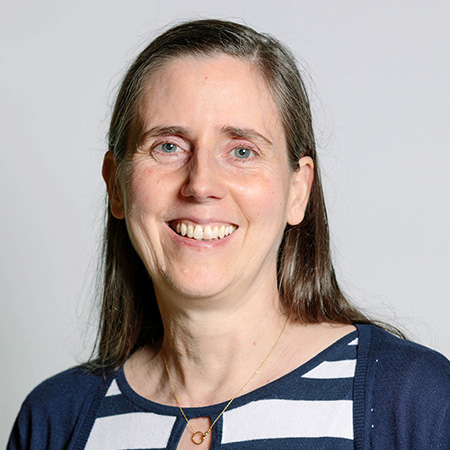
Rachel Caruso
RMIT
Professor Rachel Caruso is the Deputy Director at GETCO2 and a RMIT Distinguished Professor in the School of Science, working in the discipline of Applied Chemistry and Environmental Science at RMIT University. She leads a research group that investigates approaches to control the morphology and composition of inorganic materials with potential application in areas such as photocatalysis, photovoltaics and batteries.
Rachel was the Enabling Capability Platform Director of Advanced Materials at RMIT, and a former ARC Future Fellow. She has done pioneering work in nanoscale design of material structure and composition to enhance the performance of energy conversion (photovoltaics) and storage (lithium battery) and her work will be applied to GETCO2's Research Theme 1 - Electrode & Electrolyser and Flagship Program 1 - Multicarbon compounds via carbon-carbon bond formation.
Rachel is leading GETCO2's commitment to Equity, Diversity & Inclusion, and advocating for women in STEM. Learn more about Rachel's ambitions here. | |
More about Rachel >> |
|
|
|
|
|
|
|
CENTRE PUBLICATIONS
- Zhao Y.; Shi Z.; Li F.; Jia C.; Sun Q.; Su Z.; Zhao C. (2024) Deciphering Mesopore-Augmented CO2 Electroreduction over Atomically Dispersed Fe-N-doped Carbon Catalysts, ACS Catalysis, DOI 10.1021/acscatal.3c05144
- Zhang Y.; Dastafkan K.; Zhao Q.; Li J.; Zhao C.; Liu G. (2024) Stable tetravalent Ni species generated by reconstruction of FeB-wrapped NiMoO pre-catalysts enable efficient water oxidation at large current densities, Applied Catalysis B: Environmental, DOI: 10.1016/j.apcatb.2023.123297
- Xiao Y.; Dastafkan K.; Su Z.; Rong C.; Zhao C. (2024) Decoupling the contributions of industrially relevant conditions to the stability of binary and ternary FeNi-based catalysts for alkaline water oxidation, Journal of Materials Chemistry A, DOI: 10.1039/d3ta03905f
- Guo H.; Wu S.; Chen W.; Su Z.; Wang Q.; Sharma N.; Rong C.; Fleischmann S.; Liu Z.; Zhao C. (2024) Hydronium Intercalation Enables High Rate in Hexagonal Molybdate Single Crystals, Advanced Materials DOI: 10.1002/adma.202307118
- Chen Z.; Ma T.; Wei W.; Wong W.-Y.; Zhao C.; Ni B.-J. (2024) Work Function-Guided Electrocatalyst Design, Advanced Materials, DOI: 10.1002/adma.202401568
- Zou Z.; Dastafkan K.; Shao Y.; Zhao C.; Wang Q. (2024) Electrocatalysts for alkaline water electrolysis at ampere-level current densities: a review International Journal of Hydrogen Energy, DOI: 10.1016/j.ijhydene.2023.07.026
- Assafiri A.; Jia C.; Thomas D.S.; Hibbert D.B.; Zhao C. (2024) Fast and Sensitive Detection of Ammonia from Electrochemical Nitrogen Reduction Reactions by 1H NMR with Radiation Damping, Small Methods, DOI: 10.1002/smtd.202301373
- Jia C.; Zhao Y.; Song S.; Sun Q.; Meyer Q.; Liu S.; Shen Y.; Zhao C. (2023) Highly Ordered Hierarchical Porous Single-Atom Fe Catalyst with Promoted Mass Transfer for Efficient Electroreduction of CO2, Advanced Energy Materials, DOI: 10.1002/aenm.202302007
- Wang Z.; Hu T.; Tebyetekerwa M.; Zeng X.; Du F.; Kang Y.; Li X.; Zhang H.; Wang H.; Zhang X. (2024) Electricity generation from carbon dioxide adsorption by spatially nanoconfined ion separation Nature Communications, DOI:10.1038/s41467-024-47040-x
- Chen G.; Ge L.; Kuang Y.; Rabiee H.; Ma B.; Dorosti F.; Kumar Nanjundan A.; Zhu Z.; Wang H. (2024) Hollow fiber gas-diffusion electrodes with tailored crystal facets for tuning syngas production in electrochemical CO2 reduction, Chemical Engineering Journal, DOI: 10.1016/j.cej.2024.151651
- Dieu Thuy U.T.; Huan T.N.; Zanna S.; Wilson K.; Lee A.F.; Le N.-D.; Mensah J.; Dasireddy V.D.B.C.; Liem N.Q. (2024) Cu and Zn promoted Al-fumarate metal organic frameworks for electrocatalytic CO2 reduction, RSC Advances, DOI: 10.1039/d3ra07639c
- Sun K.; Tebyetekerwa M.; Zhang H.; Zeng X.; Wang Z.; Xu Z.; Rufford T.E.; Zhang X. (2024) Electrode, Electrolyte, and Membrane Materials for Electrochemical CO2 Capture, Advanced Energy Materials
- Wang Y.; Wu Z.; Azad F.M.; Zhu Y.; Wang L.; Hawker C.J.; Whittaker A.K.; Forsyth M.; Zhang C. (2024) Fluorination in advanced battery design, Nature Reviews Materials, DOI: 10.1002/aenm.202400625
- Zou Z.; Zheng Z.; Chen Y.; Shao Y.; Zheng X.; Zhao C.; Wang Q. (2023) Ethanol combustion-assisted fast synthesis of tri-metal oxides with reduced graphene oxide for superior overall water splitting performance, Inorganic Chemistry Frontiers, DOI: 10.1039/d3qi02046k
- Sun Q.; Zhao Y.; Tan X.; Jia C.; Su Z.; Meyer Q.; Ahmed M.I.; Zhao C. (2023) Atomically Dispersed Cu-Au Alloy for Efficient Electrocatalytic Reduction of Carbon Monoxide to Acetate, ACS Catalysis, DOI: 10.1021/acscatal.2c06145
- Jia C.; Sun Q.; Zhao C. (2023) From bulk metals to single-atoms: design of efficient catalysts for the electroreduction of CO2, Chemical Communications, DOI: 10.1039/d3cc01581e
|
|
|
|
|
|
|
|
|
The ARC Centre of Excellence for Green Electrochemical Transformation of Carbon Dioxide (GETCO2) is supported by the Australian Government through the Australian Research Council. |
|
|
|
|
|
|
|

Follow us on LinkedIn
|
|
|
|
|
|
|

Join our mailing list
|
|
|
|
|
|
|

Visit our website
|
|
|
|
|
|
|
|